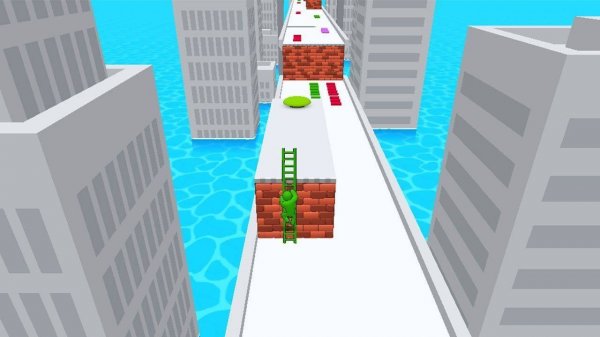
Skyward Step Climber delivers a focused single-player experience where precision and timing matter more than speed. Its bright visuals, simple controls, and lack of leaderboards make it accessible to younger players and anyone seeking a low-stress challenge. The gradual difficulty ramp introduces obstacles and faster movement without feeling unfair. The main limitation is that it offers no multiplayer or external competition, so players who thrive on social comparison may find it too solitary.
In Skyward Step Climber, the goal is simple: collect scattered ladder segments and assemble them into a tower that stretches high enough to touch the moon. You control a character moving along a linear path, and each color-coded piece you gather automatically attaches to the growing structure. The challenge comes from navigating obstacles and gaps that appear along the route. Every successful pickup extends your ladder, while missed pieces or collisions slow your progress. The game rewards precision and rhythm, asking you to balance speed with accuracy to maximize your final height.
Bright, saturated colors and simple geometric shapes define the game world. Backgrounds shift through pastel gradients as you advance, and the moon remains a constant visual goal, growing larger as your ladder rises. Character animations are smooth and expressive, with small celebratory gestures after each collection. There are no dark or threatening elements, which keeps the tone family-friendly and suitable for young children and casual players. Sound effects are minimal and cheerful, supported by a gentle musical score that increases in tempo as your speed picks up.
The difficulty curve is gradual. Early stages feature wide paths with few obstacles, giving you room to learn the controls and collection mechanics. As your ladder grows, the path narrows, obstacles become more frequent, and your character moves faster. Later sections require you to anticipate patterns and make split-second decisions about which pieces to prioritize. The game never introduces unfair elements; instead, it tests how well you have internalized the basic mechanics. This progression makes each attempt feel like a learning experience rather than a frustrating repetition.
Skyward Step Climber focuses on individual improvement rather than competitive multiplayer. There are no leaderboards or timed events that compare you against strangers. Instead, the game tracks personal bests and milestones, such as the tallest ladder you have built or the most pieces you have collected in a single run. This design reduces pressure and encourages repeated play for self-satisfaction. You can set your own targets, like reaching a certain height or completing a run without missing a piece. The lack of external competition makes the experience more meditative and accessible to those who prefer solo challenges.
The control scheme is intentionally minimal: tap or click to move your character left or right. No additional buttons or complex inputs are required. This simplicity makes the game playable on touchscreens, desktop browsers, or with a mouse. Responsive controls ensure that actions feel immediate, which is critical for a game that relies on timing. Visual cues, such as highlighted paths and color-coded obstacles, help you quickly identify what to collect and what to avoid. A pause feature and adjustable sound settings accommodate different play environments. These choices lower the barrier to entry, allowing anyone to pick up and play without prior experience.









Comments
0 comments