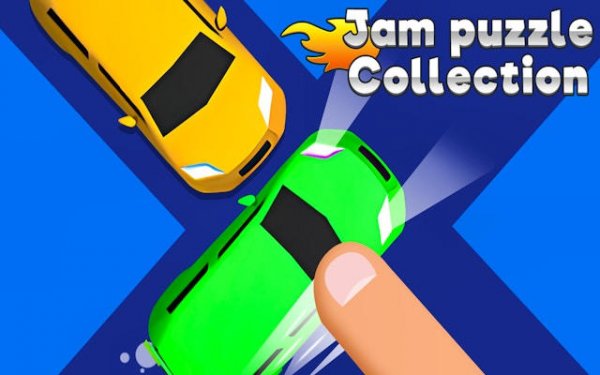
Traffic Flow Puzzle Challenge strips the sliding-block formula down to a single input: tap a vehicle, it moves one space. The depth comes from the grid itself, where every car and truck you shift changes the options for everything else. Step and time limits discourage guessing and push players to read the whole board first. The gradual difficulty curve and hundreds of puzzles suit commuters and logic-puzzle fans, though anyone hoping for varied mechanics or fast action will find the game deliberately narrow.
Every level of Traffic Flow Puzzle Challenge presents a grid packed with cars and trucks. Each vehicle faces a fixed direction, and tapping it moves that vehicle one space forward. Your job is to guide every vehicle off the board without two of them colliding. The control scheme is deliberately minimal: there is no dragging, no rotating, and no multi-step command. One tap equals one move. That simplicity puts the entire challenge on your planning rather than your dexterity.
Levels come with both a step limit and a time limit, so brute-force tapping rarely works. An early move that looks harmless can block a lane you need later, turning a solvable board into deadlock. Because each action changes the layout for every remaining vehicle, you have to read the grid as a connected system instead of a set of independent pieces. The step counter and timer act as guides: they tell you whether your route is efficient or merely possible.
The puzzle set is structured so new concepts appear before they are combined. Early boards teach you how a single vehicle's path interacts with its neighbors; later ones stack those interactions until the correct sequence is far from obvious. Hundreds of puzzles are included, and the difficulty curve is steady rather than spiky. That makes the game approachable for newcomers while still giving experienced logic-puzzle players boards that require genuine foresight.
Success depends on identifying which vehicles block the most paths and clearing them first. Scanning for those bottlenecks before making any move prevents the gridlock that comes from reacting one tap at a time. When a board feels stuck, the useful question is not which vehicle can move, but which vehicle must move first for the rest to have room. Patience and pattern recognition matter more than speed, even with the timer running.



Comments
0 comments