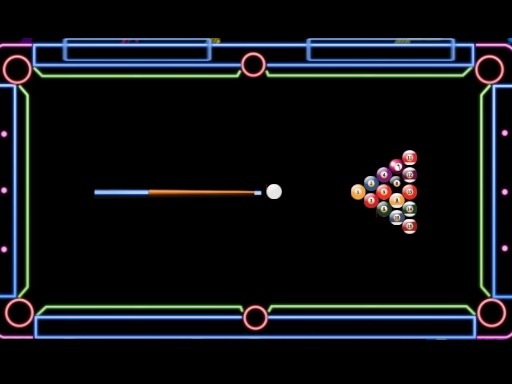
Neon Billiards Challenge is a straightforward pool game distinguished by its neon presentation and dual modes. The core loop—sink all balls while saving the 8-ball—is easy to grasp, and the pull-and-release shooting works on both desktop and mobile. PvP provides direct competition, while PvC offers solo practice. The game does not claim advanced physics or extensive customization, so players seeking deep simulation may find it limited. However, for casual matches or quick sessions, its clean interface and responsive controls make it a accessible choice.
Neon Billiards Challenge keeps the familiar goal of pool: sink every numbered ball. The twist is visual—the table and balls emit vibrant neon colors that make each shot easy to track. The 8-ball must be pocketed last; hitting it early ends the match immediately. This single rule shapes every decision, forcing you to plan around the 8-ball rather than treat it as just another target.
You can play against another person in PvP mode or face the computer in PvC mode. PvP is a direct contest of aim and strategy, while PvC lets you practice patterns and shot selection without pressure. Both modes use the same table and rules, so skills transfer between them. The game does not specify difficulty levels for the computer, but the core challenge remains consistent: control the cue ball and clear the table in the right order.
Shooting is handled with a mouse or finger. You aim by moving the cue stick around the screen, then pull back to set power and release forward to strike. The farther you pull back, the harder the shot. This pull-and-release system works on desktop and mobile, and the interface provides clear visual feedback about which balls remain. Responsive controls mean the main challenge is judging angles and speed, not fighting the input method.
Improvement comes from repetition. Watch how the cue ball reacts after contact to anticipate where it will stop. Use the table cushions to reposition for your next shot instead of relying on straight lines. Take easier pots first to build confidence, and always think one shot ahead about which ball to target next. Playing the computer is a low-risk way to test strategies before trying them against a human opponent.





Comments
0 comments