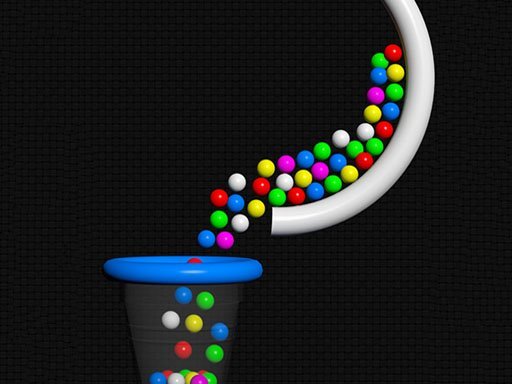
Ball Drop Precision Challenge is a casual puzzle game built around a single clear mechanic: tilt a board, release a ball, land it in a basket. Its strength is accessibility, with simple controls and colorful visuals that keep attention on the puzzle. Difficulty grows through layout complexity and obstacles rather than new systems. The main limitation is variety, since the core loop stays the same throughout. It best suits players who enjoy patient, angle-based challenges in short sessions.
In Ball Drop Precision Challenge, your only job is to get each falling ball into the basket below. The board tilts left or right, and that angle decides where the ball travels after release. Because the ball follows a path set by the board, every drop becomes a small physics problem: too steep and the ball overshoots, too shallow and it stalls short. Success depends on reading the board's position and releasing at the right moment. The game is built around precision and patience rather than speed, so rushing usually costs you the shot.
As you move through the game, layouts become more demanding. Later stages introduce obstacles or moving elements that force you to observe patterns before dropping. These additions change the puzzle without complicating the controls. You still tilt and release, but the window for a clean drop narrows. That gradual shift from simple straight shots to layouts requiring sharper observation is what gives the game its staying power. Each successful drop fills the basket and moves you forward.
The interface stays clean and uncluttered, and the on-screen controls are responsive. Tilting the board is intuitive enough that new players can focus on the puzzle rather than learning a control scheme. This low barrier suits the casual, family-friendly design. Colorful visuals keep the screen readable, and the calm presentation makes short sessions feel relaxed rather than demanding. You can play for a few minutes or longer without losing track of the goal.
Improvement comes from small, deliberate adjustments. Watching how each ball travels teaches you the relationship between board angle and trajectory. Consistency matters more than speed, so lining up each shot carefully pays off. Over repeated attempts, you develop a feel for how much tilt produces a given path. That feedback loop, where each miss informs the next attempt, is the game's main source of depth. It rewards steady hands and careful planning rather than fast reflexes.






Comments
0 comments