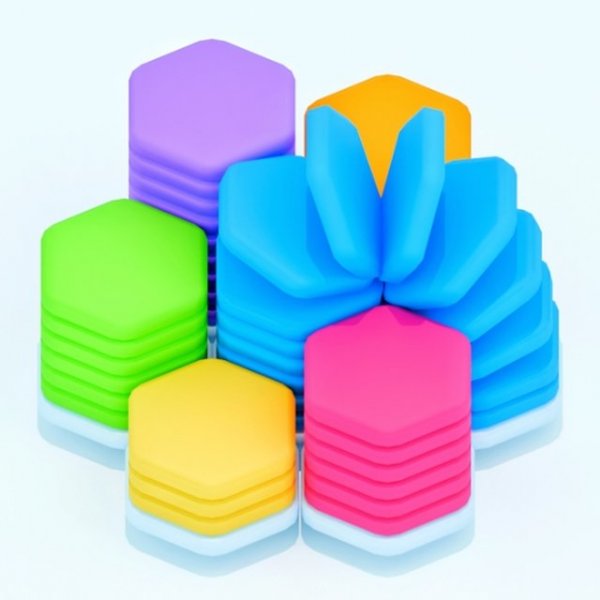
Hexagon Tile Sort Puzzle takes the familiar color-sorting formula and adapts it to a hexagonal board, where six-way adjacency changes how you plan each move. The early levels are forgiving, using only two or three colors, but the game gradually adds more colors and reduces empty space, turning simple sorting into a spatial puzzle. Its HTML5 build means it runs smoothly on most devices, and the family-friendly rating makes it easy to recommend for casual players or younger children. The main limitation is that the core loop may feel repetitive for those seeking deeper strategy, but the progressive challenge and clean controls keep it engaging for short sessions.
Hexagon Tile Sort Puzzle swaps the usual square board for a honeycomb layout. Each tile occupies a cell, and you can move it to any adjacent empty cell that shares a side. The goal is to group tiles of the same color into stacks of at least ten. When a tile lands next to a matching color along a shared edge, the two combine automatically. Keep feeding the stack until it hits ten, and the whole group disappears from the board. Because adjacency only counts along shared edges, the hex grid forces you to think about six directions instead of four, which changes how you plan routes and block space.
Early levels use just two or three colors, so you can practice basic moves without much pressure. As you advance, the game introduces more colors and shrinks the available space, making each placement matter more. The challenge comes from managing limited empty cells while trying to line up matching tiles. You cannot simply shove tiles around; you need to create pathways and avoid trapping colors in corners where they cannot connect to a growing stack.
Playing is straightforward: click or tap a tile, then select an adjacent empty cell to move it. The game runs in HTML5, so it works in a browser on PCs, smartphones, and tablets. Full-screen mode is available for a more focused session. The design is family-friendly and suitable for ages three and up, though older players will find more to think about as the difficulty ramps up.
Focus on one color at a time to build stacks efficiently. Keep similar colors near each other so you can merge them without crossing the whole board. Use the entire grid to create pathways, and avoid blocking cells that you will need later for stacking. As more colors appear, slow down and evaluate each move instead of rushing. Regular play helps you read the hex layout faster and spot stacking opportunities before they disappear.







Comments
0 comments