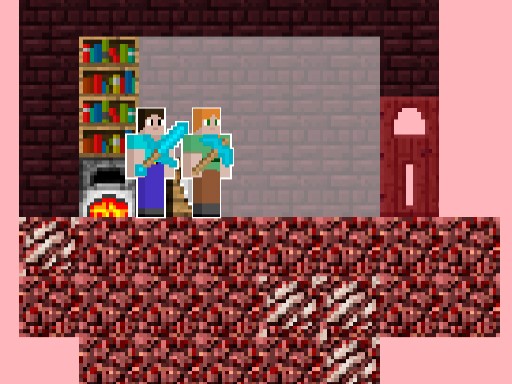
Nether Journey Cooperative Puzzle Game targets pairs who want a cooperative puzzle experience without combat or time pressure. Its strengths are the two-player coordination, simple controls, and family-friendly design. The red-tinted world and hidden traps encourage careful observation. The main limitation is that it requires exactly two players, so solo players cannot access it. It suits patient teams who enjoy discussing each move and learning from mistakes.
Nether Journey Cooperative Puzzle Game drops two characters into a strange, red-tinted world after they are drawn through a portal. The only way out is to find another portal that leads back home. Progress depends on working as a pair, not on speed or combat. One player might need to activate a switch while the other crosses a newly opened path, so every move is a shared decision. The setting is filled with hidden traps and simple puzzles that punish rushed actions and reward careful observation.
Players control two characters as they move through a map of obstacles and puzzles. The game may require alternating control or simultaneous actions to advance. For example, one character could hold a switch to keep a path open while the other moves through. Avoiding traps and finding safe routes are essential. Controls are simple and intuitive, which keeps the focus on coordination instead of mechanical skill. Communication between players is not optional; it is the main tool for solving each room.
The content is designed to be family-friendly, with no violent or inappropriate themes. Difficulty comes from environmental puzzles and trap placement rather than enemies or time pressure. Players who enjoy working together to solve challenges and discover secrets will find the game appealing. The red-tinted world hides surprises, so scouting ahead and discussing each step before acting can prevent repeated mistakes. Patience and teamwork matter more than speed.
This game suits pairs who want a calm, cooperative puzzle experience. It is accessible to players of all ages because the controls are simple and the puzzles are integrated into the environment. The focus on partnership and the unusual setting make it a distinctive entry in the puzzle genre. If you prefer solo play or fast-paced action, the two-player requirement and observation-heavy pace may not match your preferences.





Comments
0 comments