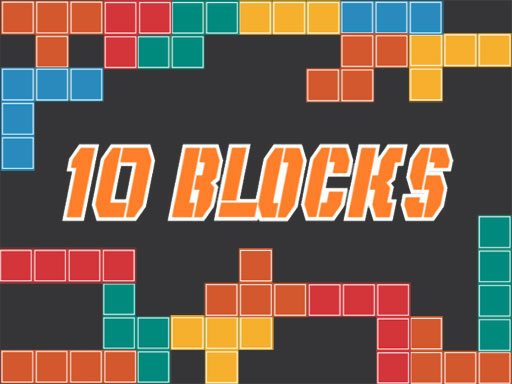
10 Block Grid Puzzle strips the genre down to spatial reasoning. The no-rotation rule and mandatory three-block sets create a steady tension between clearing lines early and saving space for awkward shapes. There is no timer, so the challenge is purely mental. Casual players will appreciate the clean presentation and gentle learning curve, while puzzle veterans may find the lack of rotation a refreshing constraint. The main limitation is that the input does not describe additional modes or scoring depth, so replay value depends on your appetite for the core loop.
Every move in 10 Block Grid Puzzle begins with a set of three colored blocks. You select one block, place it on an empty cell, then repeat until all three are on the board. Only after the full set is placed does the next set appear. This constraint forces you to think about the entire trio before committing to a single placement.
Completing a full horizontal row or vertical column removes that line from the grid, freeing up cells for future blocks. The mechanic sounds simple, but the no-rotation rule changes everything. A block shaped like an L or T only fits in specific orientations, so you cannot twist it to squeeze into a gap. Clearing lines early keeps the board open; letting blocks pile up in one region quickly shrinks your options.
Because pieces cannot be rotated, spatial reasoning matters more than reflexes. There is no timer, so you can study the grid and plan several moves ahead. The challenge comes from anticipating where the next three-block set might fit while dealing with the current one. The game ends when no block from the current set can be placed anywhere on the grid.
The clean design and family-friendly presentation make it accessible to casual players, while the increasing difficulty as the grid fills appeals to puzzle enthusiasts who enjoy planning under spatial constraints. Sessions can be short or extended, depending on how long you can keep the board manageable.



Comments
0 comments