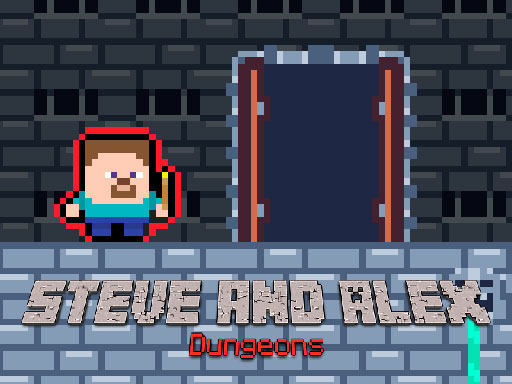
Escape the Dungeon Puzzle Platformer is built around a clear idea: two characters, two separate paths, one exit. The diamond-collection and door-unlocking loop gives each stage a purpose beyond simply reaching the end. Simple controls and a lack of violent content make it easy to pick up, while spinning wheels and timed jumps provide a mild but real challenge. It suits players who prefer calm, methodical puzzle platforming over fast action.
Escape the Dungeon Puzzle Platformer puts two characters, Steve and Alex, in a dungeon with no shared route. Each one follows an independent path, so you control them one at a time rather than moving both simultaneously. The separation is the game's defining constraint: progress on one side does not automatically help the other, and a level only ends when both characters reach the exit door. That structure turns every stage into two smaller timing problems that you solve in sequence.
Obstacles include spinning wheels, rocks, and pits. Spinning wheels can push a character backward or end the run outright, which makes them the most disruptive hazard because they punish both position and timing. Rocks and pits are simpler but still require a well-timed jump. Diamonds serve a dual purpose: they add to your score and they unlock doors that block progress. Skipping a diamond is not always fatal, but it can leave a door closed and force a restart of that character's route.
Movement uses the arrow keys or on-screen controls, with a dedicated jump button for clearing rocks and pits. The control scheme is deliberately simple, which keeps attention on when to jump rather than on complex inputs. Because each character is handled separately, the real skill is reading obstacle patterns and committing to a jump at the right moment. Rushing tends to cause mistakes, especially around spinning wheels that shift position or timing.
The difficulty rises gradually across levels, rewarding careful observation over fast reflexes alone. There is no violent content, and the family-friendly theme suits short play sessions. Players who enjoy mild challenge, precise timing, and a clear goal will find the structure accessible, while those expecting fast action or complex mechanics may find the pace deliberately slow.









Comments
0 comments