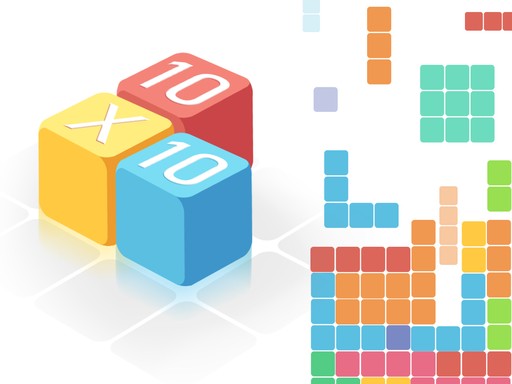
10x10 Grid Puzzle keeps its rules simple: place three blocks, clear lines, and avoid filling the board. Rotation adds meaningful decisions, and the lack of a timer makes it easy to pick up for short sessions. It suits players who prefer thinking ahead to reacting quickly. The main limitation is that the core loop stays the same throughout, so variety comes from your own planning rather than new mechanics.
Each turn gives you three blocks to place anywhere on a 10 by 10 grid. The goal is to fill entire horizontal or vertical lines; completed lines vanish and award points. You cannot receive a new set until all three blocks are placed, so every decision affects the next. The board fills up gradually, and the game ends when no block can fit. That simple loop—place, clear, repeat—drives the entire experience.
Before placing a block, you can rotate it by tapping or clicking. Rotation matters because awkward shapes often fit only in specific orientations. A block that seems useless in one position may complete a line after a quick turn. This adds a layer of planning beyond basic placement. You are not just filling space; you are reshaping pieces to match the gaps left by earlier moves. The challenge comes from balancing immediate line clears against keeping the board open for future blocks.
There is no timer. You can study the board, test rotations mentally, and place blocks at your own speed. That lack of pressure makes the game suitable for short breaks or longer sessions. The rules are easy to learn, but the strategic depth—anticipating where the next three blocks might go, avoiding fragmented empty spaces—keeps it engaging. Because the game ends only when no placement is possible, your score reflects how well you managed space over time, not how fast you clicked.
Players who enjoy spatial reasoning and careful planning will find a steady mental workout here. The rotation feature rewards foresight, and the three-block limit forces you to think about consequences. It is not a reflex game; patience and board awareness matter more than speed. If you like puzzles that let you pause and consider your next move, this structure supports that style. The clean design keeps attention on the grid, and the absence of time pressure makes it approachable for a wide range of players.



Comments
0 comments