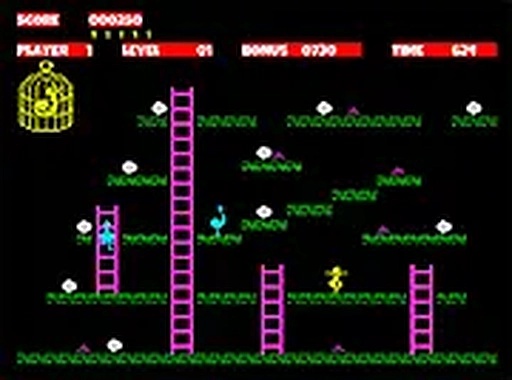
Nest Runner sticks to classic arcade fundamentals: a countdown, simple movement, and hazards that punish careless routing. The seed mechanic adds a worthwhile risk-reward decision, and the three-cycle structure paces enemy variety sensibly. Players who enjoy timing-based platformers and score chasing will find the most value. The main limitation is that the formula stays consistent throughout, so those wanting constant new mechanics may find it repetitive.
Each side-scrolling stage in Nest Runner gives you one clear task: gather every egg scattered across the environment before the countdown reaches zero. Movement is limited to left and right, with ladders and elevators connecting platforms. The layout forces you to plan a route rather than react randomly, because the timer keeps running while you decide. Falling into a gap at the bottom of the screen ends the run immediately, so every climb and elevator ride carries a small risk.
Ostriches patrol platforms and ladders in the early stages, and their size makes them easy to spot but hard to slip past without correct timing. A duck that actively chases your character appears in later stages, adding pressure from behind while you still need to watch the timer. The final cycle combines both threats, so you manage a patrolling obstacle and a pursuing one at the same time. Elevators help you reach higher platforms quickly, but stepping onto one at the wrong moment can carry you toward an enemy instead of away from it.
Piles of seeds sit throughout each stage. Collecting them before an ostrich eats them pauses the countdown briefly and adds bonus points to your score. This creates a real decision: chase eggs for completion or detour for seeds to buy time and points. Every 10,000 points earned grants an extra life, which rewards efficient, high-scoring play rather than simply finishing a stage. You begin with five lives, and each mistake costs one.
The game is divided into three cycles. The first focuses on ostriches, the second introduces the chasing duck, and the third mixes both enemy types. This structure lets you learn the timing and routing basics before the most demanding stages. Across 24 stages, the difficulty rises in a way that tests route planning, hazard timing, and seed collection under a single countdown. The online format makes short sessions easy to start, while the score system and extra-life threshold give a reason to replay for better results.









Comments
0 comments