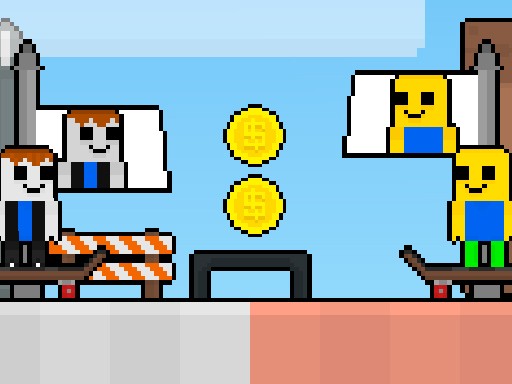
Skateboard Obby Two Player Arcade focuses on coordination between two players controlling Obby and Bacon. The challenge comes from synchronized movement across ramps, gaps, and moving blocks, with checkpoints softening falls. Its family-friendly design and simple controls suit pairs looking for a shared test of timing. The main limitation is that solo play is not supported, since the game is built around two active participants.
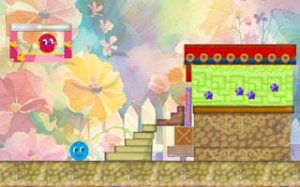
Skateboard Obby Two Player Arcade is built around a simple partnership: one player controls Obby, the other controls Bacon. Both characters must move across narrow paths filled with skateboard ramps, gaps, and moving blocks. The goal is to reach the finish line together. Because the game is designed for two players, neither character can succeed alone. If one falls, the pair restarts from the last checkpoint. That rule shapes every decision, since a risky jump by one player directly affects the other.
Players use the arrow keys or WASD to steer their character. The challenge comes from synchronizing movement. Ramps require enough speed to clear a gap, while moving blocks demand precise timing to step on or avoid. Since both characters share the same screen and obstacles, spoken or signaled coordination matters more than raw reflexes. A jump that works for one skater may leave the other exposed, so the pair must agree on when to move, wait, or backtrack. The controls are easy to learn, but the levels reward patience over rushing.
Levels are arranged to become progressively harder. Early sections introduce basic ramps and gaps, then later stages combine moving blocks with tighter timing windows. Each new obstacle builds on the previous one, so the game teaches through repetition rather than text prompts. Checkpoints reduce frustration by limiting how much progress is lost after a fall. The result is a steady difficulty curve that keeps the experience fresh without sudden spikes. Players who prefer a relaxed pace can still enjoy the game, while those seeking a coordination test will find it in the later stages.
This is a family-friendly arcade title with no violent or frightening content. It works best for two players in the same room, since communication is central to success. The cooperative focus makes it a natural fit for friends, siblings, or parents playing with children. Solo players will find the game less rewarding because the core mechanic depends on two active participants. The simple controls and checkpoint system also make it approachable for younger or less experienced gamers, provided both players are willing to coordinate.





Comments
0 comments